

As Africa approaches 2030, the deadline for achieving the Sustainable Development Goals (SDGs), an important question remains: Where do we want Africa to be by 2063, and what are we doing today to get there?
On September 25, 2026, SDSN Youth Africa Network Coordinators brought together young leaders, development practitioners, and members of the African Diaspora Community for a regional conversation titled “From 2030 to 2063: Reimagining Africa’s Sustainable Future Through Youth Action.”
The conversation explored the relationship between the 2030 Agenda for Sustainable Development and the African Union’s Agenda 2063, while focusing on one central idea: Africa’s future cannot be built without young people being meaningfully involved in building it.
The event was moderated by Michael Kishoyian, SDSN Youth Network Coordinator for Kenya, who opened the session by highlighting the work of SDSN Youth and the Africa Regional Network Coordinators in creating spaces for young people across the continent to engage in sustainable development.
Michael highlighted the importance of regional collaboration and creating opportunities for young people from different countries and backgrounds to exchange ideas and contribute to Africa’s sustainable future.
The opening remarks were delivered by Raquel Armendariz, SDSN Youth Global Manager.Raquel reflected on her position as someone from outside Africa, acknowledging that she may not necessarily be the person best positioned to speak about Africa’s development. However, she shared her perspective on the kind of Africa she hopes to see.
She expressed her desire to see a developed Africa where the Sustainable Development Goals are meaningfully implemented, resources are used effectively, and the continent continues to build partnerships that effectively advance toward sustainable development.
Her remarks opened the door to a wider discussion: What exactly is the Africa we want, and what must be done today to build it?
The panel discussion was moderated by Dibora Kebede, Regional Focal Point for Africa at SDSN Youth, and brought together diverse perspectives from young leaders working across different areas of sustainable development.
The panel included Gisele Ishimwe and Elizabeth Zion, representing the African Diaspora Community; Joshua Alade, Founder of Nigeria Youth SDG; Ryan Okello, Founder and CEO of the Ryan Okello Foundation; and Micaela Gota.
The discussion explored youth participation, economic development, education, the role of the African Diaspora, renewable energy, trade, institutional trust, and what it would take to move from development strategies to meaningful implementation.
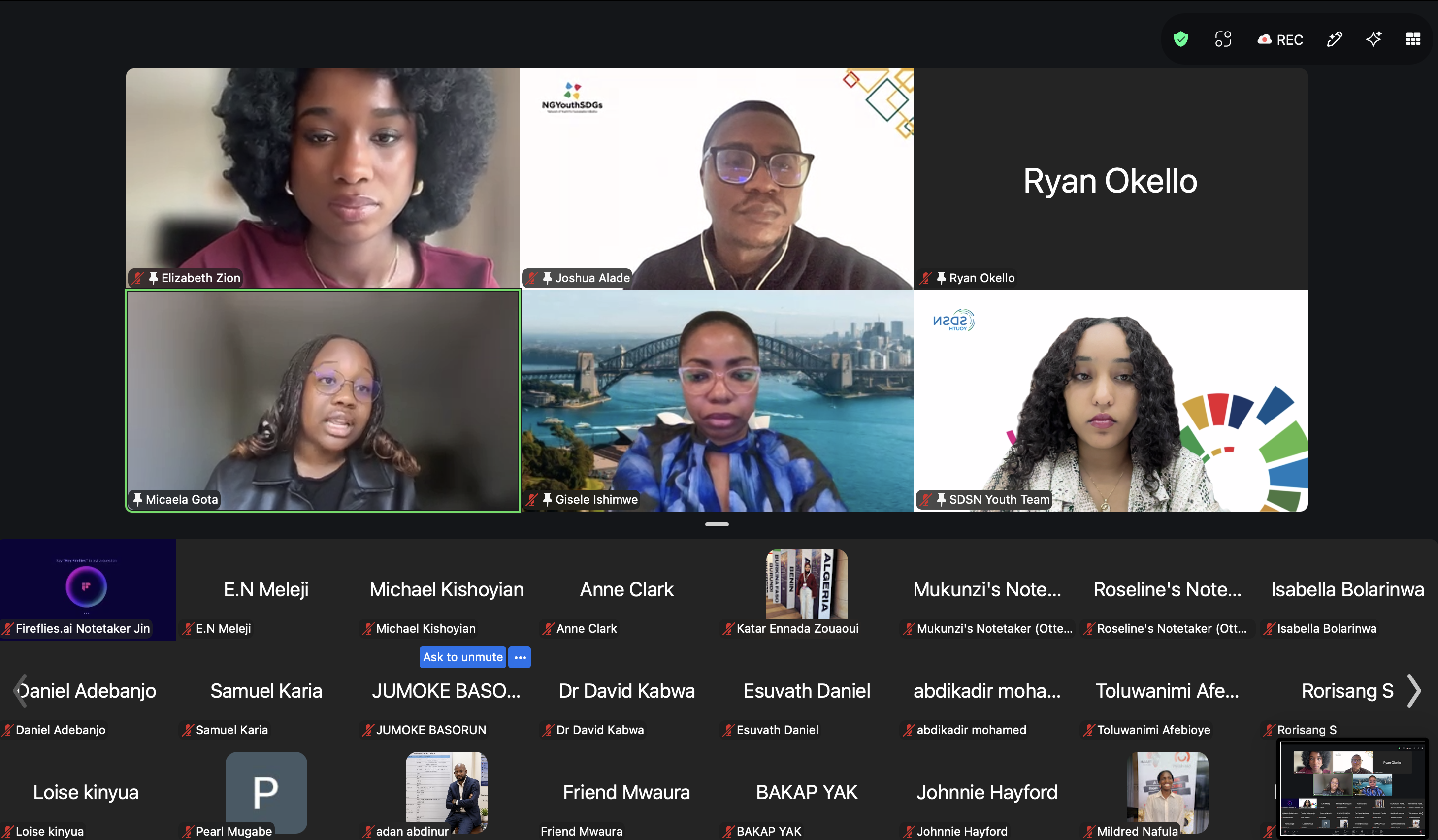
Micaela Gota emphasized that understanding the Sustainable Development Goals must be the starting point for meaningful youth engagement.
She stressed the importance of first introducing African young people to the SDGs and making the goals understandable and accessible.
Accessibility is key. We cannot effectively achieve the SDGs if people are not on the same page about what they mean and how they can contribute.
Her point highlighted an important question: before asking young people to implement the SDGs, are we making sure they have access to the knowledge, information and opportunities necessary to participate?
Joshua Alade, Founder of Nigeria Youth SDG, brought a strong sense of urgency to the conversation.
Joshua challenged the idea of treating 2063 as a distant future. With only 37 years remaining until 2063, he argued that young people should not have to wait until then to experience the Africa they want.
The Africa we want needs to start being built today.
He highlighted the importance of building trust in institutions, increasing access to businesses and economic opportunities, strengthening trade, supporting the free movement of goods, and creating meaningful employment opportunities for young people.
But Joshua also raised a deeper question about youth participation.
Young people are often invited to conferences and panels to speak about their experiences and ideas. But simply giving young people a platform to speak is not enough.
Rather than only speaking, we need to make sure young people's voices are influential.
Young people need defined roles in development processes and meaningful opportunities to influence decisions—not simply invitations to comment after decisions have already been made.
Ryan Okello, Founder and CEO of the Ryan Okello Foundation, focused on Africa's economic potential and the need to move beyond seeing young people simply as beneficiaries of development.
He highlighted opportunities for Africa to advance in areas such as mining, trade and exports, emphasizing that the continent has the potential to do much more with its resources and economic opportunities.
Ryan argued that young people should not be treated only as beneficiaries of development, but also as makers of development.
He also highlighted the opportunities presented by renewable energy, noting that Africa has significant potential to create new economic and employment opportunities through the transition to sustainable energy.
Africa, he argued, is not lacking strategies. The challenge is turning those strategies into meaningful action and opportunities.
The participation of Elizabeth Zion and Gisele Ishimwe, representing the African Diaspora Community, brought an important perspective to the conversation.
Elizabeth emphasized that Africa cannot build the future it wants by continually relying on debt and external financing. She highlighted the importance of knowledge, while also noting that knowledge alone cannot fill every development gap.
For Elizabeth, the African Diaspora can play an important role by acting as a bridge—opening doors, creating opportunities, sharing knowledge, and connecting people and institutions.
She also emphasized the importance of individual agency.
Agency can be built through small actions.
Transformative change does not always begin with large institutions or major initiatives. It can begin with individuals taking small but meaningful steps in their communities and creating opportunities for others.
Gisele Ishimwe brought another dimension to the conversation by discussing the experiences of the African Diaspora.
She highlighted challenges around belonging, racism, finding a place to live and build a life after leaving one's country or continent, and the wider issue of brain drain.
At the same time, she emphasized that the Diaspora can play an important role in supporting Africa—but that this role should be approached as a bridge rather than as an attempt to speak for Africa.
The African perspective must remain at the center.
In every conversation involving Africa, the continent's own experiences, priorities and perspectives should be part of the foundation of that conversation.
Gisele also highlighted education as one of the important pathways toward bringing Africa closer to the “Africa we want.”
The event concluded with reflections from Dr. David Kabwa, who described Africa as standing between two horizons.One horizon is 2030—the year by which the Sustainable Development Goals were intended to transform the world.The other is 2063—the year by which Africa has envisioned an integrated, prosperous and peaceful continent, driven by its own citizens.
Between these two horizons lies a generation.
Dr. David emphasized a vision of Africa where young people are not merely beneficiaries of development, but partners in building it.

A future where young people are not invited to decision-making only after decisions have already been made, but are sitting at the table where policies are designed, budgets are discussed, and futures are shaped.
Young people are not spectators. They are not tokens. They are leaders.
He also challenged the idea that peace should simply mean the absence of conflict.
The vision for Africa should be one where peace means justice, opportunity and dignity, not simply the silence of guns.
As Africa moves beyond 2030, the journey should therefore not be limited to achieving economic targets. It should also be about creating societies where young people have meaningful opportunities, where development is inclusive, and where peace, justice and dignity are part of everyday life.
The conversation ultimately returned to one central message:
We cannot wait until 2063 to start building the Africa we want.
The year 2063 may seem far away, but for today's young generation, it is a future they may personally experience.
The Africa that exists in 2063 will be shaped by decisions being made today—decisions about education, employment, climate, energy, governance, technology, peace, trade and youth participation.
Africa already has strategies and ambitious development frameworks. The challenge is turning those visions into action.
And young people must be part of that process—not only as participants, beneficiaries or speakers, but as decision-makers, innovators, entrepreneurs, researchers, policymakers and builders of development.
The African Diaspora also has an important role to play by creating bridges, opening doors, sharing knowledge and building connections while ensuring that African perspectives remain at the center.
The SDGs provide a framework for 2030. Agenda 2063 provides a longer-term vision for the continent.
But frameworks alone cannot build the future.
People do.
Young people do.
Communities do.
Institutions do.
And the choices we make today will determine the Africa we see tomorrow.
2063 is 37 years away. The Africa we want begins today.