
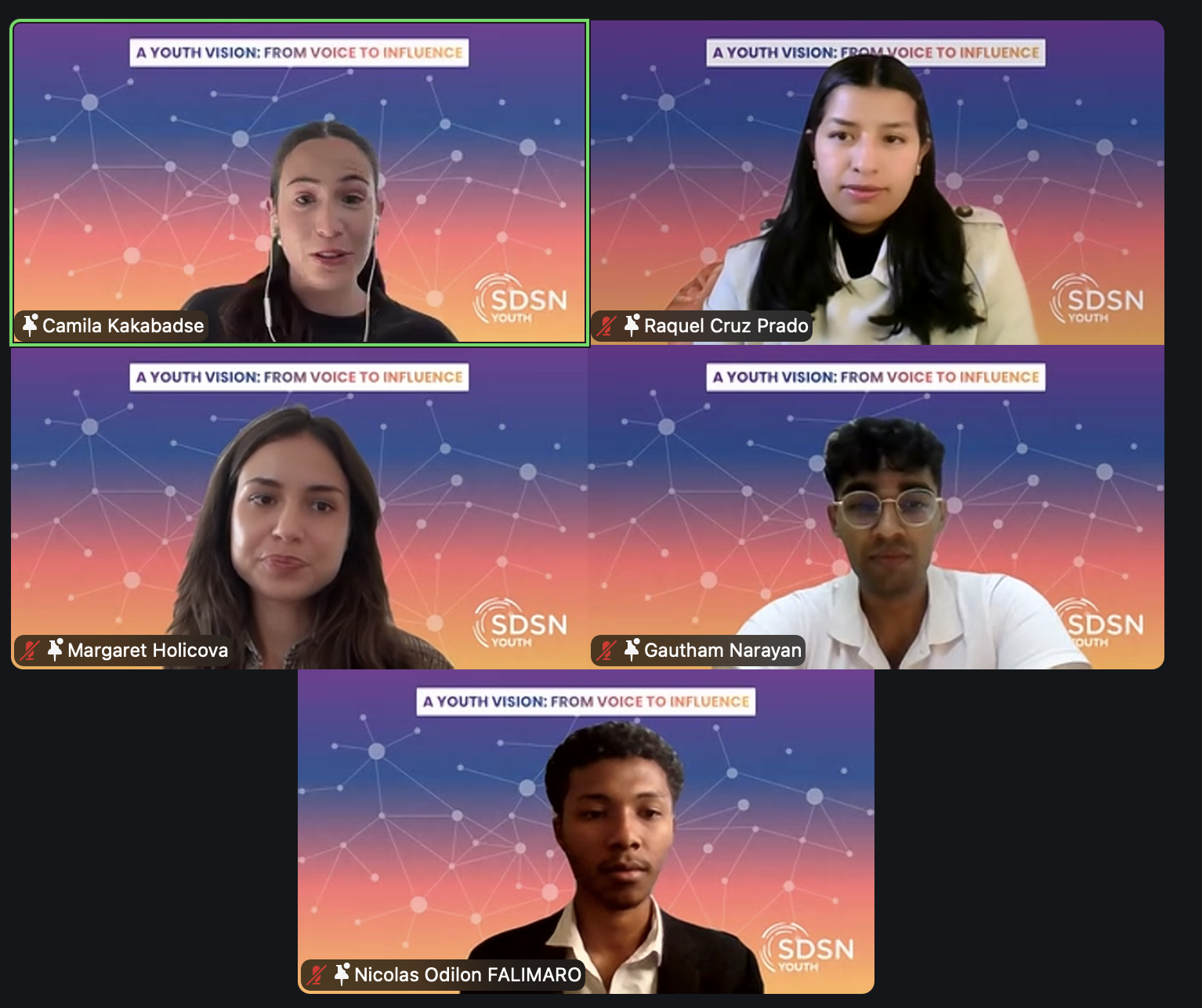
As global leaders gather for the United Nations General Assembly at a critical moment for the global development agenda, SDSN Youth hosted Youth Vision for the World’s Future: From Voice to Influence, a conversation exploring what meaningful youth participation looks like and how young people can move from being consulted to having a genuine role in shaping the decisions and frameworks that will define the post-2030 agenda.
The conversation brought together four young leaders and youth development practitioners from different regions:
Moderated by Camila Kakabadse, Events and Partnerships Lead at SDSN Youth, the discussion built on SDSN Youth’s A Youth Vision for the World’s Future, an initiative that brought together the perspectives of more than 400 young people across Africa, the Americas, Asia and the Pacific, and Europe around gender equality, climate change, and the future of work.
Rather than presenting these regional perspectives as a finished product, the conversation explored what they mean for the way institutions engage with young people — and what needs to change for youth participation to translate into real influence.
The conversation opened by asking whether 2026 truly feels like an inflection point for global development.
For Raquel, the answer depends on where young people are experiencing that change. While international discussions increasingly focus on artificial intelligence, digitalization, innovation, and emerging jobs, young people in rural communities in Bolivia continue to face more immediate challenges, including limited internet access, informality, lack of employment opportunities, and limited access to training.
For many young people, development must ultimately translate into decent work, decent employment, and real economic opportunities.
Nicolas brought a perspective from Madagascar and the wider African region, where climate change is increasingly affecting communities, resources, and economic opportunities. He emphasized that communities need to consider new approaches to addressing these challenges rather than relying solely on traditional systems.
Across these perspectives, one tension emerged clearly: global conversations do not always reflect the realities young people experience on the ground.
A central question throughout the discussion was what happens after young people are invited to speak.
Margaret emphasized that creating spaces for young people to share their perspectives is an important starting point, but it cannot be the endpoint. Youth consultations and formal participation mechanisms already exist in many contexts. The chal
Drawing on her experience with Women Beyond Borders, she highlighted the importance of moving from connection to practical responsibility. Young people need opportunities to lead projects, contribute to research, manage initiatives, and take on responsibilities that allow them to build experience.
Nicolas similarly reflected on the importance of creating pathways between young people's lived experiences and international policy discussions. Platforms such as A Youth Vision for the World’s Future can help connect youth perspectives on climate, energy, employment, and inclusion with broader global conversations.
The message was consistent: meaningful participation cannot end with consultation. There needs to be a visible pathway from youth perspectives to recommendations, decision-making, and action.
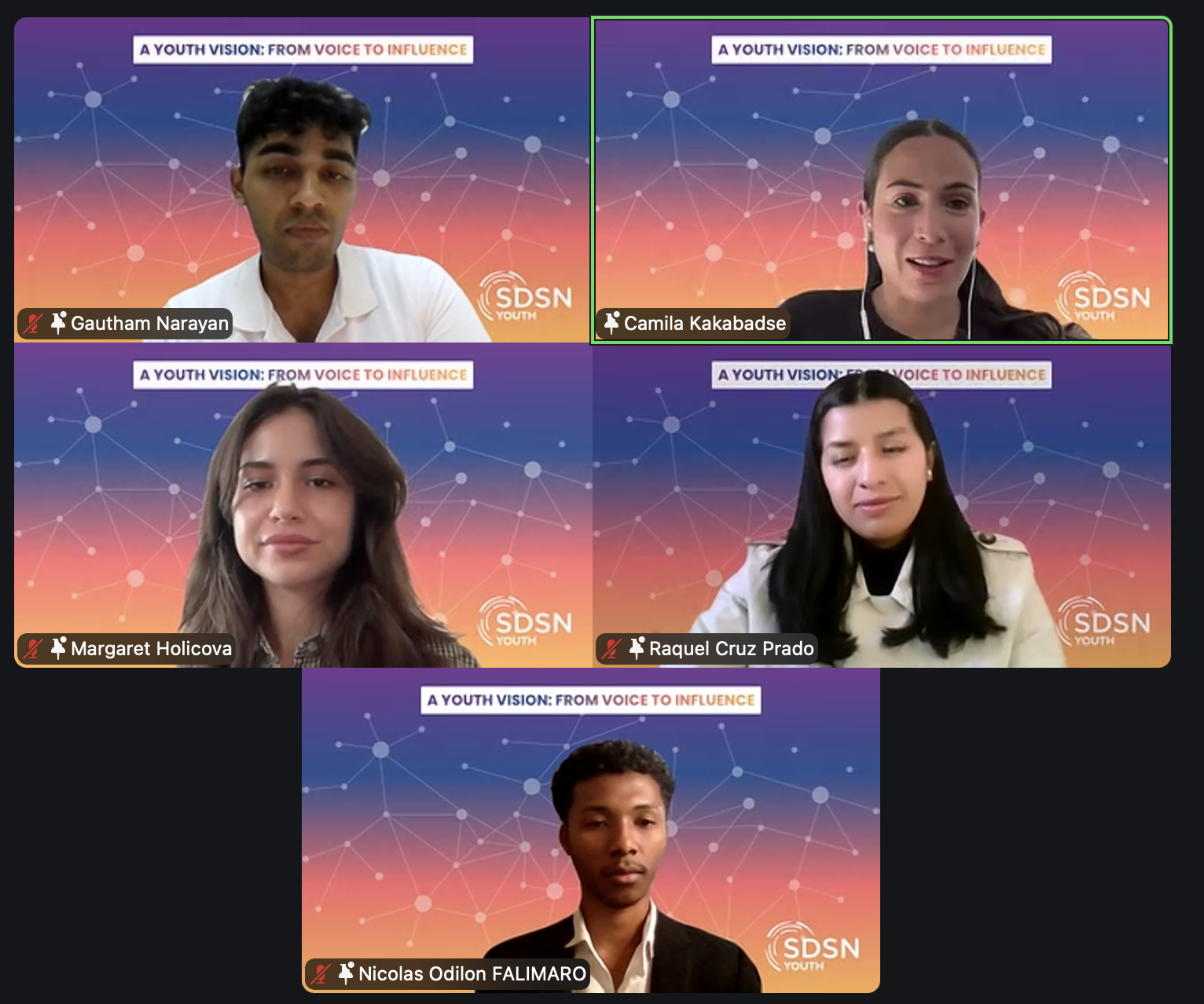
The regional dialogues highlighted important differences in how young people experience development, while also revealing common concerns across regions.
Gautham, who participated in several of the regional consultations, reflected on a shift he has observed in youth conversations over time. Young people are increasingly speaking less about what they want to see in the future and more about what they need to see now.
Whether discussing economic opportunities, better cities, water management, climate action, or political accountability, these priorities are increasingly framed as immediate needs rather than distant aspirations.
In the Americas, Raquel highlighted growing concern about the rapid development of artificial intelligence and its implications for education and employment. Young people are questioning whether the jobs they are preparing for today will exist tomorrow, while also asking for more opportunities to understand and use emerging technologies.
Margaret highlighted another common concern: the transition between education and meaningful work. Young people may leave university with strong qualifications but still face limited entry-level opportunities and job descriptions requiring years of prior experience. Creating opportunities for young people to take on genuine first responsibilities is essential to helping them build the experience they need to enter the workforce.
The discussion then turned to the relationships that make meaningful youth engagement possible. For Gautham, equitable partnerships require moving beyond the symbolic inclusion of a young person or youth organization simply to demonstrate that youth are represented.
He reflected on experiences where youth organizations were invited into advisory or consultative spaces, but their participation risked becoming a way to “tick the box” of youth engagement.
Raquel emphasized that equitable partnerships should begin at the design stage, rather than only during implementation. Young people should have access to networks and decision-making spaces, as well as opportunities to lead.
She also highlighted structural barriers facing smaller youth-led and community-based organizations, including funding requirements and administrative processes that can make it difficult for them to access opportunities.
Partnership, therefore, is not simply about inviting youth into existing systems. It also means examining whether those systems allow youth-led organizations to participate meaningfully in the first place.
Looking toward the frameworks that will shape the post-2030 era, Margaret argued that youth participation needs to be built into these processes from the beginning.
Rather than designing frameworks for young people and asking for their opinions afterward, young professionals and youth organizations can be involved in drafting, implementation, evaluation, and budget discussions.
She also called for greater transparency around what happens to youth recommendations: which recommendations are adopted, which are not, and why.
This is particularly important because young people do not experience issues such as climate change, gender equality, employment, technology, migration, and education as separate policy categories. These issues intersect in their everyday lives, even when institutions address them through separate departments, programs, and budgets.
For Gautham, accountability needs to be embedded within the frameworks themselves. Future agendas should establish clear and measurable expectations for implementation, while young people also have a role in following policies, understanding decisions being made in their countries, and holding decision-makers accountable.
The goal is not simply to create better mechanisms for asking young people what they think. It is to create systems where young people can look back at the policies, projects, and solutions that emerged and say: we helped build that.
As the post-2030 agenda takes shape, the question is not only whether young people are invited to comment on the future, but whether they are given a meaningful role in building it.
Through initiatives like A Youth Vision for the World’s Future, SDSN Youth continues to create spaces where young people can bring their lived experiences, perspectives, and ideas into global conversations — and work toward a future where youth participation translates into meaningful influence and sustainable development action.
If you missed this insightful session or would like to revisit the discussion, we invite you to watch the recording here. For collaboration opportunities with SDSN Youth, contact youth@unsdsn.org.