
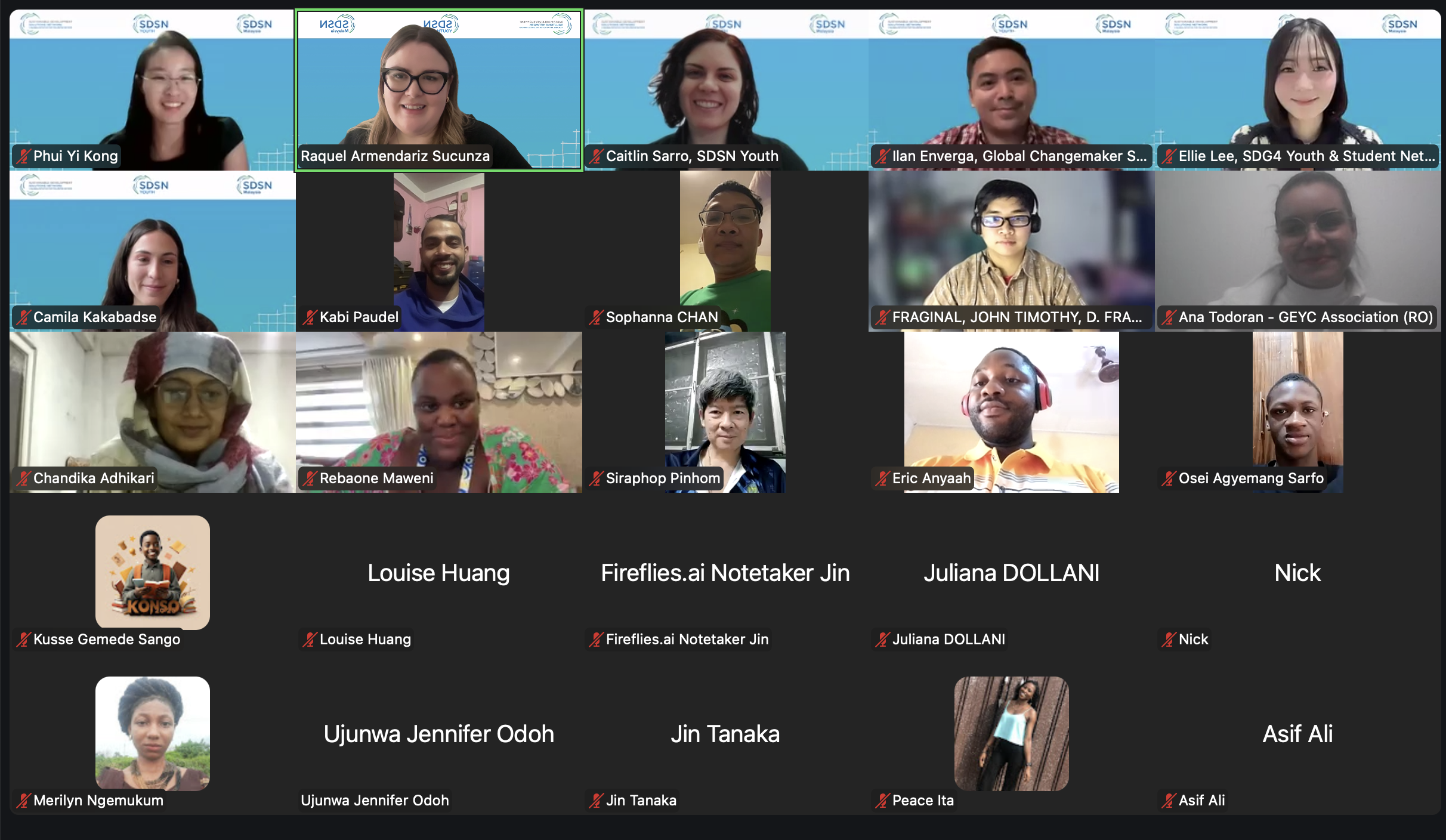
On January 24, 2026, the global community came together to mark International Education Day with a dynamic virtual event hosted by SDSN Youth, in collaboration with the SDSN Malaysia Network. This intergenerational dialogue brought leaders and educators together to explore the theme “From Learning to Action Across Generations with Education for Sustainable Development (ESD).” This year’s event was of utmost importance for SDSN Youth, as the official theme “The Power of Youth in Co-creating Education,” underlined the central role young people must play not just as learners, but as active contributors and leaders in shaping education systems worldwide.
Why Education for Sustainable Development (ESD) Matters Now & What it Really Means
The event opened with a warm welcome from host and moderator Raquel Armendariz Sucunza, SDSN Youth Global Coordinator, who reminded attendees that ESD is essential to achieving the SDGs by 2030, particularly as only four years remain to meet these targets.
The event showcased a diversity of voices, with panelists sharing perspectives from their own geographies and backgrounds. Each panelist answered a central question: “Why is ESD essential for achieving the SDGs by 2023?”
Phui Yi Kong (SDSN Malaysia Co-Manager, Education Policy Research, Analyst, SDSN Asia Headquarters, hosted by Sunway University) emphasized that society and education are deeply interconnected: “For societal transformation to happen, we really need to use schools as hubs for sustainable development… empowering students to solve the complex problems we face.” Phui Yi’s message was clear: schools should be more than knowledge factories. They must be spaces where learners develop the competencies to tackle real world challenges. On the other hand, Caitlin Sarro (Deputy Project Lead (Education & Capacity Building) SDG Student Program, SDSN Youth) highlighted education’s role in fostering a global conversation:“Education creates a shared language… across borders and communities, enabling collaboration and shared solutions.” This view underscored the power of education to connect diverse peoples and build bridges of understanding that propel collective action.
From his classroom experience, Ilan Enverga (Founder & CEO, Global Changemaker Schools) spoke about ESD as a source of actionable hope: “ESD isn’t just about hope, it’s hope that leads to action, equipping students with skills to build the society they envision.” His words resonated strongly, especially for educators who witness how learning inspires young people to envision a better future. Lastly, Ellie Lee, the Asia-Pacific Youth Rep, at the SG4 Youth & Student Network, brought in an important perspective on how ESD translates theory into lived experience: “ESD is the bridge that connects values, competencies, and action. It moves people from abstract knowledge to concrete decisions impacting their communities.” Her example of a workshop simulating refugee experiences showed how education can cultivate empathy, systems thinking, and real decision-making skills.
Challenges and Realities on the Ground
The panelists also acknowledged the persistent barriers to inclusive education, emphasizing that access alone does not guarantee meaningful participation. One example from an Indigenous community in Malaysia, by Phui Yi, illustrated how students were able to complete primary school but were unable to continue into secondary education due to social exclusion and insufficient support systems. This case underscored the reality that without societal readiness, cultural inclusion, and sustained support, educational pathways remain inaccessible despite available resources.
Digital Innovation & Learning Ecosystems
Technology and global connectivity emerged as powerful tools in expanding educational opportunities. Speakers highlighted how digital platforms are fostering cross-border learning communities where young people can exchange toolkits, share resources, and adapt ideas to fit local languages and contexts. These digital ecosystems are strengthening informal and non-formal education spaces, allowing ESD to extend far beyond traditional classroom settings.
Youth as Co-Creators of Change
Throughout the discussion, panelists reinforced the idea that young people should be recognized as active contributors rather than passive beneficiaries of education systems. Meaningful youth engagement was described as continuous and embedded, with young people involved in shaping, implementing, and evaluating educational initiatives. Examples such as global art collaborations and student-led advocacy campaigns demonstrated how youth-driven perspectives can drive transformative learning experiences.
Intergenerational Collaboration: Power & Practice
The dialogue also explored the importance of collaboration across generations. Sarro highlighted the value of mentoring and shared learning, stating youth voices should be heard, and coupled with experience from older practitioners to support sustainability. In support, Lee also urged power-sharing between generations, rather than tokenistic mentorship, advocating for decision-making spaces where all ages contribute equitably.
Actionable Recommendations for 2026 and Beyond
As the event wrapped up, speakers offered practical advice for policymakers, educators, and young advocates:
Key Takeaways
The International Education Day 2026 dialogue illustrated a fundamental truth: when young people are empowered as co-creators of education, transformative impact moves from theory into practice. Education for Sustainable Development is a lived, collective journey that equips learners of all ages with the capability to shape resilient, inclusive, and sustainable societies.
As the panel concluded with four one-word takeaways: transformation, storytelling, solidarity, and hope, these themes serve as a compelling reminder of how interconnected our efforts must be in pursuit of the SDGs.
If you missed this insightful session or would like to revisit the discussion, we invite you to watch the recording. For collaboration opportunities with SDSN Youth, contact youth@unsdsn.org